tonight i found myself thinking about a class i took in high school, in grade 11, called media arts, and about how much that class ended up shaping the way i think about creativity, learning, and what it means to actually feel understood in an educational space.
i had a teacher named ms. gillis, and she was genuinely one of those teachers who changes the course of your life in subtle ways that you don’t fully recognize until much later. she introduced us to photo editing, digital art, photoshop, and other programs in the adobe suite, and while i don’t remember most of the technical specifics anymore, i remember the feeling of being introduced to an entirely new creative world and realizing how many possibilities existed within it. that class opened up a way of making that felt expansive and exciting to me, and i’m still deeply grateful for that early exposure.
the class wasn’t only about creating things, though. we also did a lot of media analysis, which involved watching films and writing papers about them, paying attention to camera angles, transitions, zooms, framing, and the technical choices that shape how a story is told. alongside that, we were asked to think about meaning, about what a film was saying underneath the surface, why it mattered, and what cultural ideas or values it was reinforcing or challenging.
if i remember correctly, we watched four films over the course of the class: jaws, little miss sunshine, psycho, and rocky. i wrote traditional analysis essays about jaws, little miss sunshine, and psycho, but by the time we reached rocky, something in me had shifted. in my literary arts class, i had become deeply invested in poetry, and my interest in writing analytical essays had started to fade in comparison. i didn’t want to write another film analysis, and all i really wanted at that point was to write poems.
i remember asking ms. gillis if i really had to write an analysis of rocky, and telling her honestly that i didn’t want to, and that i would much rather make an alternate movie poster or do something else creative that was still connected to the class. she explained that for grading purposes, there needed to be a written component for each of the four films, but that the writing itself didn’t have to take the form of a traditional analysis, as long as it was meaningfully connected to the movie and its themes.
so instead of writing an essay, i wrote three poems about feminism. rocky is a deeply sexist film in many ways, and it is misogynistic and violent toward women, which was one of the topics we were expected to engage with in our analysis anyway. writing poetry allowed me to explore those themes in a way that felt honest and alive to me, rather than forcing my thoughts into a structure that no longer fit how i was thinking or creating.
i think about that moment often, partly because of how happy it made me at the time, and partly because of what it represented. ms. gillis didn’t force me into a rigid mold or punish me for not wanting to engage in the expected way; instead, she trusted that i could demonstrate understanding through a different form. she recognized that learning and critical thinking don’t only exist in one shape, and that allowing flexibility doesn’t mean lowering standards, but rather inviting deeper engagement.
i wonder often how many students would benefit from that kind of approach, and how different school might feel if more people were allowed to apply what they’ve learned through the things they genuinely care about. i know that if i had been given more opportunities to write poetry instead of essays in situations where it made sense, i would have been a happier student, a stronger writer, and more deeply engaged in my learning. being able to work through ideas using a medium that already felt natural to me allowed the material to actually sink in, rather than feeling like something i was simply trying to get through.
i still write poetry now, and that is directly because of teachers like ms. gillis, as well as my literary arts teacher, ms. james, who also saw my potential and pushed me to take my creative writing seriously. ms. gillis gave me access to digital tools and creative flexibility, while ms. james encouraged me to explore language, emotion, and form more deeply, and together they created a foundation that continues to shape my work.
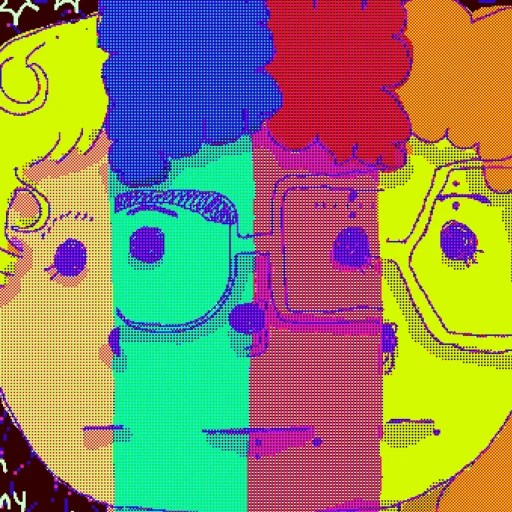
over time, my poetry naturally began to evolve into other forms, often turning into collage, digital edits, or becoming integrated into my drawings, until the boundaries between text and image started to blur in a way that felt intuitive rather than forced. i don’t think i would be the artist i am today without teachers who noticed what i was drawn to and made space for it, instead of insisting that learning had to look a single, specific way.
there’s a clear throughline between the work i make now and that high school classroom where i was told i didn’t have to write an essay as long as i wrote something meaningful and true. every time i let poetry spill into visual work, or allow words and images to exist together, i’m carrying forward the permission i was given back then, and continuing to believe that creativity and understanding are at their best when they’re allowed to take the form they need.
To all the Women
To all the women,
All the brilliant diversities;
From the tall, thin like sky brushing trees,
To short, plump, bodies like bounty.
From all edges of my heart I salute to
The gradient of brown to black skin
Rich like gold and honey,
And the women, untouched by this raw,
Ruthless injustice, who knew,
Who saw the discrimination between
Colours that could not be changed and
Stood up.
To all the women,
All the bra burners;
Burden bearers, mothers, daughters and sisters
Who knew they were more than a pair of working hands,
Burnt and withered away in a kitchen,
Behind the smoking, merciless shadows of men who
Loved, provided and lived, but claimed all success.
From all the edges of my heart I salute to
The women who never stopped, whose feet melted into the floor where they stood
Melted like the butter they through in a pan, melted like days gone by
Unfulfilled by the things they could never do,
Who sacrificed to grow up and raise me
And more women after that, whose unconditional love
Pushed their daughters forward to
Stand up.
To all the women,
All the colours of the rainbow;
From being different at birth,
To finally having the courage to come forth.
To all the ladies who love ladies,
Full of everlasting beauty and peace.
And the ladies who could finally exist as themselves,
Marching forwards with perseverance and grace.
From all the edges of my heart I salute to
The resilience of pride,
And knowing that our love will not be illegal,
That freedom is free, no matter what,
Because together,
We are still standing.
this is the poem i ended up writing for that rocky assignment. it’s difficult for me to read now, mostly because my work has evolved so much since then, and also because i was sixteen or seventeen when i wrote it, still very much figuring out what my voice was and what i wanted to say. even so, i’m really proud of myself for standing up and asking to do something different, and i’m deeply grateful that i was given the opportunity when i asked for it.
i think a lot of students grow up believing they don’t have permission to ask for alternatives, that the curriculum is rigid and must be followed exactly as it’s given, with no room for accommodation or flexibility. in many cases, that belief isn’t unfounded. there are plenty of classrooms where modification feels impossible, where students are expected to be quiet, listen, take notes, and perform well on paper, regardless of whether that structure actually works for them. but that isn’t fair, and it shouldn’t be treated as normal.
there are so many students who learn in different ways, and they shouldn’t be expected to leave their schools or be funneled into alternative programs simply because they struggle with a standardized model of learning. they deserve proper accommodations in the schools they want to attend, alongside the friends and communities they already belong to. i know people who went to alternative schools and found a sense of belonging there, which is meaningful and real, but i still find myself wondering what it would look like if we created those same opportunities within mainstream classrooms.
what if we met students where they already are instead of asking them to relocate themselves in order to be understood?
what if we explicitly told students that they are allowed to ask for what works for them, and that learning isn’t a fixed transaction where you either succeed within the given structure or fail outside of it? i was fortunate to attend a school that was open to creative students, a place that drew in many different kinds of minds. i was in an arts-focused program, specifically literary arts, and that environment is where i truly flourished. i know that if i had stayed at the catholic uniform school i attended previously, i wouldn’t be who i am today, and i’m not even sure i would have made it through in the same way.
that’s the part that stays with me the most. i didn’t thrive because the system worked universally, but because i happened to land somewhere that allowed flexibility and creativity. i was lucky. but what if it didn’t have to come down to luck? what if all kids were given the chance to learn in ways that honored how they think, feel, and create, without having to ask for permission in the first place? i am not a psychologist or a sociologist in any way, so i don’t really have some grand answer or theory, but i think many of us would be better off.

Leave a comment